

Chairman:
Dr. Adrian Reyes
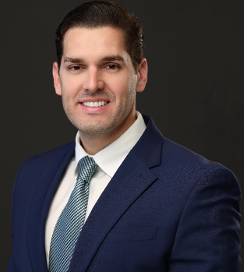
Dr. Adrian Reyes was born and raised in Hialeah, Florida, where he developed a passion for giving back and serving his community. He earned his Bachelor’s degree in Biochemistry from the University of Florida and continued his education at the University of Florida College of Dentistry, where he received his Doctor of Dental Medicine degree.
Dr. Reyes practiced as a general dentist for several years, gaining broad clinical experience before pursuing specialty training in endodontics. He completed his formal endodontic training at Nova Southeastern University in Davie, Florida, where he received his Certificate in Endodontics. His background in general dentistry contributes to his clinical and diagnostic approach as an endodontic specialist, with experience in both nonsurgical and surgical endodontic procedures.
Dr. Reyes is a licensed endodontic specialist and a strong supporter of organized dentistry. His professional memberships include the American Dental Association, American Association of Endodontics, Florida Association of Endodontics, and Florida Dental Association. He is also certified in Nitrous-Oxide sedation and Basic Life Support in accordance with the American Heart Association.
Course Description
Recent Advances in Endodontic Diagnosis, Treatment Planning and Treatment presents a focused exploration of essential principles and contemporary approaches in endodontic care. Through a four-part lecture series, participants will examine the diagnostic process, root canal disinfection, cleaning and shaping techniques, and the management of previously treated teeth requiring nonsurgical retreatment.
The course emphasizes careful diagnosis, effective treatment planning, preservation of tooth structure, thorough disinfection, and evidence-based clinical decision-making with the goal of achieving predictable treatment outcomes while preserving the natural dentition whenever feasible.
Course Topics
Lecture #1 — Endodontic Diagnosis: A Case Report
A clinical case involving a mandibular buccal bifurcation cyst demonstrates the importance of comprehensive testing and accurate differential diagnosis. Participants will examine how vitality assessment and advanced imaging helped distinguish a non-endodontic lesion from endodontic pathology, allowing appropriate treatment while avoiding unnecessary endodontic intervention.
Lecture #2 — Irrigants & Irrigation Methods
This lecture reviews the essential role of irrigation in achieving thorough canal disinfection during root canal therapy. Topics include sodium hypochlorite, chelating agents such as EDTA, smear-layer removal, proper irrigation protocols, potential chemical interactions, and contemporary activation techniques. Particular attention is given to balancing antimicrobial effectiveness with clinical safety.
Lecture #3 — Cleaning and Shaping
Participants will review the fundamental principles and techniques involved in cleaning and shaping the root canal system, including the progression from traditional hand instrumentation to modern nickel-titanium rotary systems and the complementary role of chemical irrigants. The lecture addresses mechanical debridement, preservation of tooth structure, and development of a continuously tapered preparation suitable for three-dimensional obturation.
Lecture #4 — Nonsurgical Retreatment
The final lecture addresses the management of post-treatment endodontic disease through nonsurgical retreatment. Participants will explore methods for removing previous root-filling materials, posts, and separated instruments to regain apical access, followed by cleaning, shaping, and obturation. The discussion emphasizes evidence-based decision-making and preservation of the natural dentition whenever feasible.
Together, these lectures provide a clinically focused review of the endodontic treatment process—from establishing the correct diagnosis and treatment plan through disinfection, canal preparation, and management of challenging retreatment cases.